
Home › Apprenticeships & traineeships › Data and Voice Communications

Certificate III in Data
and Voice Communications
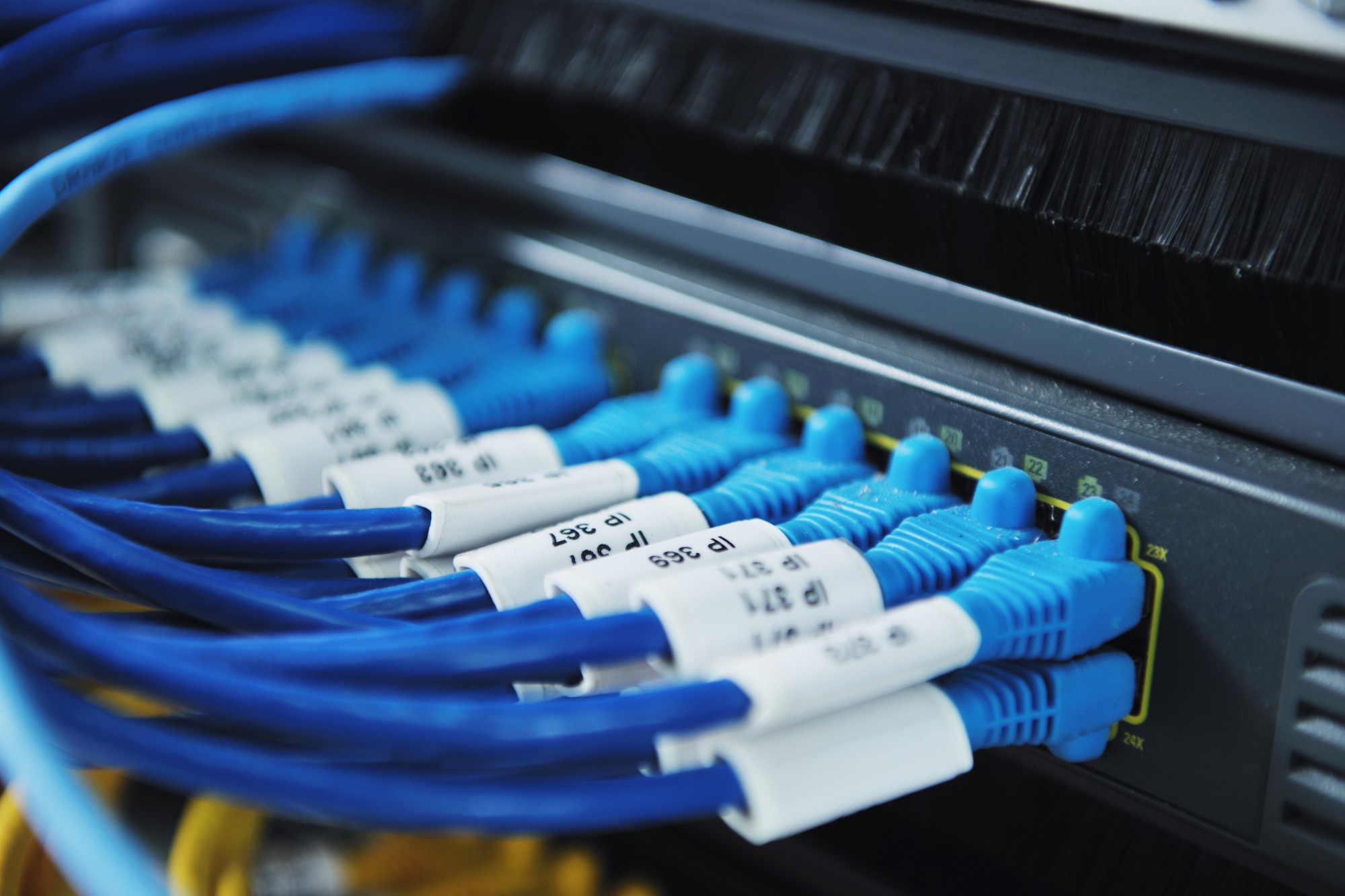
Labelled blue patch leads terminated into a network switch in a comms rack

Selecting, installing, setting up, testing, fault-finding, repairing and maintaining telecommunications and high-performance data services in buildings and premises — and it includes the ACMA requirements for Open Cabler Registration.

Structured cabling Optical fibre Coaxial Data and voice equipment Local area networks Wireless networks Testing and fault rectification Work health and safety
UEE30425 · Release 1
Apprenticeship

Paid work with a host employer, with the structured training and assessment delivered by us at Myaree.

About 36 months
232 hours in the classroom, about 29 days
7 workplace visits from a trainer
22 units, 954 nominal hours
Training at 1A / 5 Hayden Crt, Myaree WA
How it is broken up

7 modules

Each module runs the same way: a block of face-to-face training and practical work at Myaree, then self-paced online theory to consolidate it, then assessment of the same skills on a real job — at the end of that module, not all at the end of the course. The unit codes under each block are what gets signed off.

MODULE 1 6 units

Introduction to Data and Voice

5 days face to face

The trade foundation: industry and safety regulations, controlling WHS risks, fabricating and securing equipment, and solving problems in DC circuits. The largest single block, at six units.

UEECO0027Engage in communications, security equipment or fire protection work and competency development
UEECD0007Apply work health and safety regulations, codes and practices in the workplace
UEECD0016Document and apply measures to control WHS risks associated with electrotechnology work
UEECD0020Fix and secure electrotechnology equipment
UEECD0019Fabricate, assemble and dismantle utilities industry components
UEECD0043Solve problems in direct current circuits
MODULE 2 3 units

Telecommunications Networks

4 days face to face

Drawings, standards and schedules, extra-low voltage cabling, and the unit carrying the ACMA Cabling Provider Rules. Finishing this and module 1 gives the units to apply for Open Cabler Registration.

UEECD0051Use drawings, diagrams, schedules, standards, codes and specifications
UEECD0025Lay wiring/cabling and terminate accessories for extra-low voltage (ELV) circuits
UEEDV0005Install and maintain cabling for multiple access to telecommunication services
MODULE 3 2 units

Network Infrastructures

4 days face to face

Coaxial and structured copper, plus optical fibre. Added to modules 1 and 2, this gives the units for the Structured, Optical Fibre and Coaxial endorsements.

UEEDV0008Install, modify and verify coaxial and structured communication copper cabling
UEEDV0006Install and modify optical fibre performance data communication cabling
MODULE 4 6 units

Design and Construct an IP Network

4 days face to face

Setting up data communication systems and a LAN, installing and connecting data and voice equipment, selecting gear for a network, assembling and testing computing devices, and testing, reporting and rectifying faults.

UEEDV0011Set up and configure basic data communication systems
UEECS0029Set up and configure basic local area network (LAN)
UEEDV0004Install and connect data and voice communication equipment
UEEDV0009Select and arrange data and voice equipment for local area networks
UEEDV0014Test, report and rectify faults in data and voice installations
UEECS0003Assemble, set up and test computing devices
MODULE 5 1 unit

Intruder Alarm Systems

4 days face to face

Assembling and setting up basic security systems. With modules 1 and 2 this gives the units to apply for a Class 2 Security Installer / Consultant licence.

UEEEC0003Assemble and set up basic security systems
MODULE 6 2 units

Design and Construct a Wireless Network

4 days face to face

Setting up and configuring the wireless capability of communications and data storage devices, and selecting and arranging equipment for wireless networks.

UEEDV0012Set up and configure the wireless capabilities of communications and data storage devices
UEEDV0010Select and arrange equipment for wireless communication networks
MODULE 7 2 units

Work in Your Industry

4 days face to face

Troubleshooting resonance circuits in electronic apparatus, and applying environmentally sustainable procedures in the energy sector.

UEEEC0074Troubleshoot resonance circuits in an electronic apparatus
UEERE0001Apply environmentally and sustainable procedures in the energy sector
Not just the certificate at the end

What they can apply for along the way

Licensing and registration do not wait until the apprenticeship finishes. These come through as the relevant units are completed.

ACMA Open Cabler Registration

Finishing modules 1 and 2 gives the units needed to apply for an open cabler registration through an ACMA-accredited registrar — well before the apprenticeship itself is finished.

Structured, Optical Fibre and Coaxial endorsements

Modules 1, 2 and 3 together give the units needed to apply for all three endorsements on that open registration.

Class 2 Security Installer / Consultant (Alarms/CCTV)

Modules 1, 2 and 5 give the units needed to apply for the security licence as well.

Who it suits

Employers

Someone stays productive on your jobs while they qualify, and you keep a tradesperson who already knows how you work. The face-to-face training comes in short blocks rather than one long absence, and we usually talk to the employer before we meet the candidate — we help with applications and selection too.

It also works for someone already on the books. An existing-worker arrangement formalises what they are doing, and Recognition of Prior Learning cuts down what they have to sit.

Apprentices and trainees

You earn while you learn, and you finish with a nationally recognised qualification and years of real jobs behind you rather than a certificate on its own.

Where the work is: Residential work means customers’ homes and roof spaces. Commercial work covers offices, schools, government buildings, hospitals and data centres.

It leads to: Data and voice communications technician, cabling technician, registered cabler, network installer. Our ACMA open registration and endorsement short courses cover the registration side on its own if that is all that is needed.

Nationally recognised

Units of competency

22 units — 16 core and 6 elective, 954 nominal hours in total. 1,060 weighting points — 700 core and 360 general elective. 16 core units plus six electives. Elective offerings can be customised for corporate clients where it is viable.

UEECO0027
Engage in communications, security equipment or fire protection work and competency development
Core
54 hrs
UEECD0007
Apply work health and safety regulations, codes and practices in the workplace
Core
18 hrs
UEECD0016
Document and apply measures to control WHS risks associated with electrotechnology work
Core
18 hrs
UEECD0020
Fix and secure electrotechnology equipment
Core
18 hrs
UEECD0019
Fabricate, assemble and dismantle utilities industry components
Core
36 hrs
UEECD0043
Solve problems in direct current circuits
Core
72 hrs
UEECD0051
Use drawings, diagrams, schedules, standards, codes and specifications
Core
36 hrs
UEECD0025
Lay wiring/cabling and terminate accessories for extra-low voltage (ELV) circuits
Core
36 hrs
UEEDV0005
Install and maintain cabling for multiple access to telecommunication services
Core
72 hrs
UEEDV0008
Install, modify and verify coaxial and structured communication copper cabling
Core
36 hrs
UEEDV0006
Install and modify optical fibre performance data communication cabling
Core
36 hrs
UEEDV0004
Install and connect data and voice communication equipment
Core
36 hrs
UEEDV0009
Select and arrange data and voice equipment for local area networks
Core
36 hrs
UEEDV0014
Test, report and rectify faults in data and voice installations
Core
36 hrs
UEEEC0074
Troubleshoot resonance circuits in an electronic apparatus
Core
72 hrs
UEERE0001
Apply environmentally and sustainable procedures in the energy sector
Core
18 hrs
UEEDV0011
Set up and configure basic data communication systems
Group B
36 hrs
UEECS0029
Set up and configure basic local area network (LAN)
Group B
72 hrs
UEECS0003
Assemble, set up and test computing devices
Group B
72 hrs
UEEEC0003
Assemble and set up basic security systems
Group A
72 hrs
UEEDV0012
Set up and configure the wireless capabilities of communications and data storage devices
Group B
36 hrs
UEEDV0010
Select and arrange equipment for wireless communication networks
Group B
36 hrs

The detail

What the apprenticeship involves
Paid work with a host employer in telecommunications, data, voice or electronic security, alongside structured training with us. Over about 36 months it comes to 232 hours of classroom instruction and assessment — 29 days, taken in blocks of four to five days at a time — plus online theory between blocks, seven workplace visits from an Aspire trainer, and ongoing observation by the host employer.
Registration along the way
This is the part worth knowing. Finishing modules 1 and 2 gives the units needed to apply for ACMA Open Cabler Registration through an accredited registrar. Modules 1, 2 and 3 add the Structured Cabling, Optical Fibre and Coaxial endorsements. Modules 1, 2 and 5 give the units for a Class 2 Security Installer/Consultant licence. An apprentice becomes useful on paper well before the three years are up. All cabling work done during training complies with the Telecommunications (Cabling Provider) Rules 2025 and AS/CA S009:2020.
Entry requirements
The apprentice must hold an active training contract registered with the Apprenticeship Office naming UEE30425, and have a host employer working directly in the telecommunications, data, voice or electronic security industry. Literacy enough to read safety procedures and a basic understanding of maths are needed. Someone who is colour blind may have difficulty identifying individual wires and optical fibres, which can affect assessment — we can check that before enrolment.
How someone starts one
A training contract is set up between the employer and the apprentice or trainee through the Apprenticeship Office, with Aspire nominated as the training organisation. We handle our end of the paperwork and the reporting, and in most cases we talk to the employer before we meet the candidate — we help with applications and selection as well as the training.
Language, literacy and numeracy support
Every candidate completes a language, literacy and numeracy assessment before enrolment. It is built against the Australian Core Skills Framework and is used to build a profile, not to screen people out — where it flags a gap we can put structured pre-learning, extra tutorials or extra time for practicals in place. Reasonable adjustments are documented by the assessor and never compromise the validity of the assessment.
Delivery and assessment
Assessment happens at the end of each module, once the training and practical activities are done, and takes place both at Myaree and in the workplace. Evidence is collected through practical demonstration, knowledge-based questioning and workplace observation. It is competency-based: progress comes from demonstrating the work.
Recognition of prior learning
Competency from prior learning and work experience can be recognised in this qualification, through application and discussion directly with us. If someone has been doing the work for years, bring job records, photos, test results and a supervisor who will vouch for it — we would rather assess the evidence than make anyone repeat what they can already demonstrate.
The simulated environment
Our training rooms at Myaree are built to simulate real installation scenarios. The simulated environment is practical panels and network racks fitted with industry-current equipment, which each student installs as though they were in a customer’s premises — and when it comes time to hand the job over, the instructor role-plays the customer.
Fees
Fees are set by the Department of Training and Workforce Development, not by us. This qualification is 954 nominal hours at the standard apprenticeship and traineeship rate — $3.25 per nominal hour — so the full course fee is $3,100.50, or $925.38 if you hold a concession. You are charged for each unit as you start it, so the fee arrives in instalments across the qualification rather than up front. Employers often pay it for an apprentice, but that is between you and them — we invoice whoever is named on the enrolment.

Our other qualifications

All apprenticeships & traineeships →

Need it sooner?

Our short courses run on scheduled dates and finish in days rather than years.

See short courses →

Not sure this is the one?

A five minute phone call will tell you which qualification fits the role and what the commitment actually looks like.

08 9417 4113